The #1 Marketing Solution for Finance Professionals


The U.S. Added 172,000 Jobs in May. So Why Did Financial Services Lose 22,000?
June 5, 2026
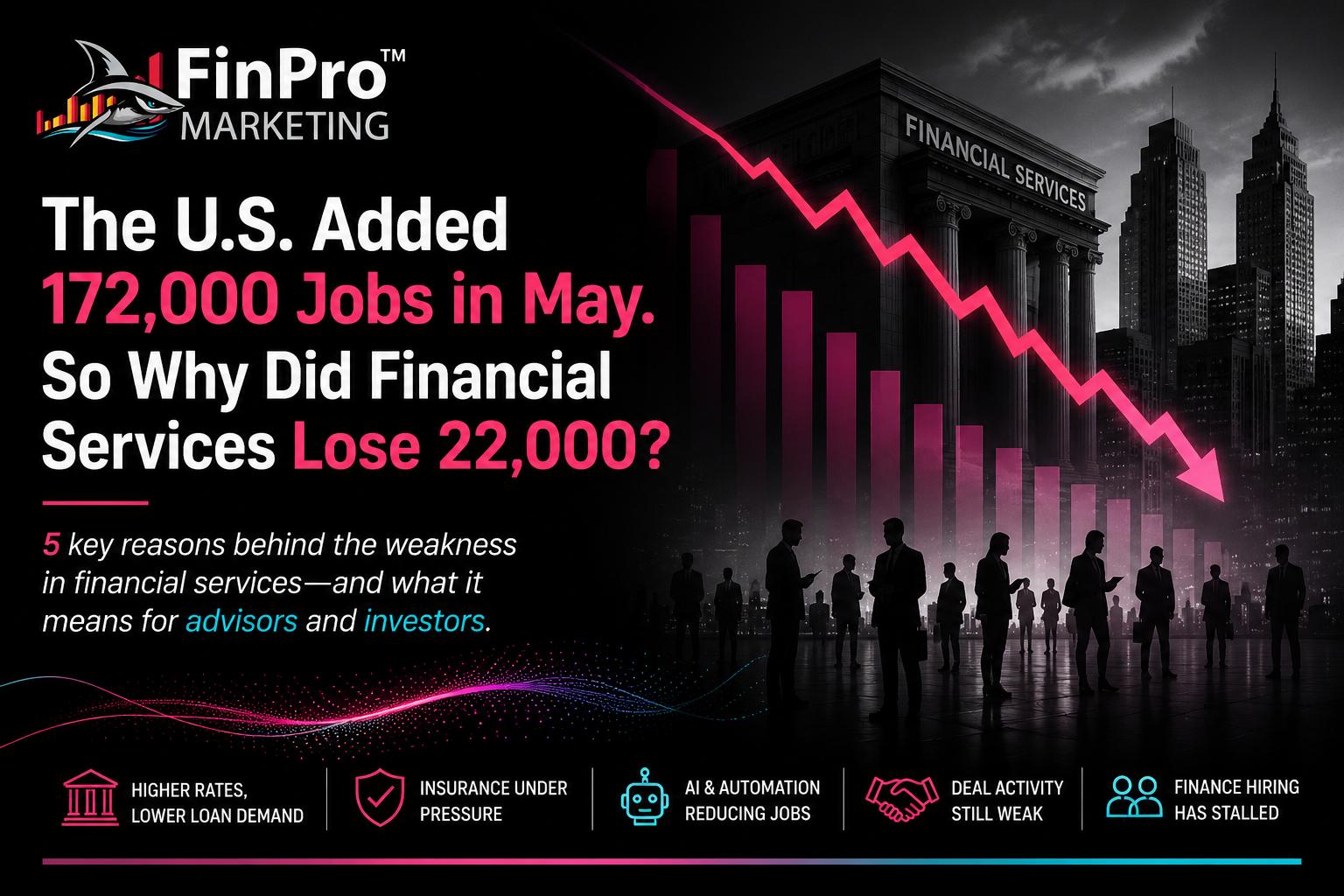
The U.S. Added 172,000 Jobs in May. So Why Did Financial Services Lose 22,000?
The headline from the May employment report was clear: the U.S. labor market remains remarkably resilient.
The economy added 172,000 jobs, nearly double economist expectations, while payroll gains from previous months were revised higher. Healthcare, hospitality, manufacturing, and local government all continued to add workers.
Yet beneath the headline, one sector stood out.
Financial activities lost 22,000 jobs.
For financial advisors, RIAs, banks, insurance companies, and wealth management firms, the decline raises an important question:
Why is financial services shedding jobs while much of the economy continues to hire?
While a single jobs report never tells the whole story, economists and industry analysts have identified several themes that may help explain the weakness.
1. Banks Are Still Adjusting to a Higher-Rate Environment
Many banks are still adapting to the realities of higher interest rates.
Loan demand remains softer than it was during the ultra-low-rate era, refinancing activity has fallen dramatically, and many regional banks continue to prioritize efficiency and cost control over expansion.
The result is a hiring environment focused more on productivity than growth.
For many institutions, adding technology has become a higher priority than adding headcount.
2. Insurance Companies Are Under Pressure
The largest employment declines within financial activities occurred among insurance carriers and related businesses.
Insurance firms continue to face multiple challenges, including:
- Rising claims costs
- Severe weather and catastrophe losses
- Healthcare inflation
- Regulatory complexity
- Technology modernization initiatives
Many insurers are investing heavily in systems and automation while slowing workforce growth.
That combination often leads to fewer new hires and increased pressure on existing teams to do more with less.
3. Automation and AI Are Beginning to Reshape White-Collar Employment
Financial services is one of the industries most exposed to artificial intelligence and automation.
Much of the work performed across financial institutions involves:
- Information processing
- Documentation
- Compliance reviews
- Customer support
- Reporting
- Data analysis
These are exactly the types of tasks AI tools are becoming increasingly capable of handling.
The technology is not replacing advisors or relationship managers.
However, it is reducing the need for certain operational, administrative, and support functions that historically required larger teams.
For financial firms, the question is no longer whether AI will impact staffing.
The question is how quickly the transition will occur.
4. Deal Activity Remains Below Boom Levels
Investment banking activity has improved from recent lows, but it remains well below the extraordinary levels seen during 2020 and 2021.
Initial public offerings, mergers and acquisitions, venture capital funding, and portions of commercial real estate finance have yet to fully recover.
When deal flow slows, firms need fewer analysts, associates, and support staff.
That reality continues to weigh on hiring across several areas of financial services.
5. Finance Hiring Has Largely Stalled
Workforce data from finance employers suggests that hiring and turnover have both slowed significantly.
Rather than aggressively recruiting, many firms appear to be holding onto existing employees while limiting new positions.
In other words, this is not necessarily a wave of layoffs.
It may be a hiring freeze.
Some analysts describe the environment as a “near-zero growth” labor market for finance professionals.
The Bigger Picture
What makes this trend particularly interesting is that the weakness appears concentrated within finance while many service sectors continue to expand.
In May alone:
- Leisure and hospitality added 70,000 jobs
- Healthcare added 35,000 jobs
- Local government added 55,000 jobs
The economy is still creating jobs.
It is simply creating them in different places than it did during much of the last decade.
For financial advisors, this trend may offer an early glimpse into a broader shift occurring throughout the economy.
As artificial intelligence, automation, and productivity-enhancing technology become more common, employment growth may increasingly favor industries that require physical presence, human interaction, and labor-intensive services.
Meanwhile, information-driven industries may learn to produce more output with fewer people.
That possibility leads to a much bigger question:
The economy added 172,000 jobs in May, but financial activities lost 22,000. Is this simply a temporary pause, or is it evidence that AI and automation are beginning to reshape white-collar employment?
That may be the most important labor market story of 2026.
Sources
- U.S. Bureau of Labor Statistics Employment Situation Report
- Barron’s
- Business Insider
- BambooHR Workforce Data
Are you a financial professional looking to level up your marketing strategy?
.
Financial Advisors Must Bet on the Team. Not the Product.
By William Lee, former CME/CBOT rate futures trader and founder of Great …
The Great Deflation of Intelligence: AI Costs Are Collapsing at Historic Speed
First Published: MIXED MARKET ARTIST Throughout modern economic history, periods of transformational growth …
Share :